Back to School sales have begun, and now is the time to think of your favorite local non-profit or school, especially if you have no kids at home to school shop. All it takes is a little organization.
1. Check the sale flyers and advertisements at office supply, technology, and department stores and websites.
2. Buy things that are free (or pennies) after rebate.
3. Fill out the rebate forms (online when you can and save the postage).
4. Donate the supplies to your favorite house of worship, school, homeless/family shelter, or other non-profit organization.
5. Get your rebates sometime in the next 4-12 weeks.
You have spent nothing (or pennies) out of pocket and have made a gift-in-kind difference to an organization that you ca use it.
Last week, Staples had a sale on copy paper. Buy up to 2 reams at 6.99, submit a rebate slip for a rebate of $6.74. Total cost: fifty cents for 2 reams. Our synagogue buys by the case and probably spends $5/ream, so my donation was realized at a $10 savings off the budget bottom line on a consumable supply that is used. Imagine if even 10 or 20 congregants or friends made that same 50-cent donation of two reams of paper. It adds up. Add in the two 10-packs of Bic pens that were a penny each and it helps all the more.
Shop early in the week to make sure you get the sale items. Quantities are limited and there is generally a limit per household.
This week:
Staples
8.5 x 11 writing pads, limit two, $.01 with any $5 purchase. exp 7/21 (reg $1.49)
Insertable 5-tab dividers, limit two, $.01 with any $5 purchase. exp 7/21 (reg $1.49)
1" 3-ring binders, limit two, $1.00 with any $5 purchase. exp 7/21(reg $2.99)
FREE after rebate Mechanical pencil 5-pack, limit one, $4.29 with $4.29 rebate. exp 7/21
Multipurpose paper, $6.99-$5.99 rebate, limit two, exp 7/21
other sale items include: 2 pack pens, pencil cases, pencil sharpeners, memo-size clipboard, rulers,
OfficeMax
4-pack yellow highlighters $1, (reg $3.29)
Office Max also has a number of deals for free or near free after rebate, but their rebate is in MaxPerks dollars you need to spend back at OfficeMax. If you shop there regularly, it's certainly a good deal.
Monday, July 16, 2012


Friday, July 13, 2012
Culinary Oxymoron: Drunk Lobsters
I found myself thinking about lobsters today, and remembered that my grandmother had a peculiar method for preparing lobsters. Bringing home the live lobsters, she would put them on a baking tray and pour in some wine. The lobsters would drink the wine. We were told that the wine made the lobsters drunk, so they felt no pain when being plopped into a pot of boiling water. We were also told that the wine made the lobster meat more tender and flavorful. As a kid growing up in Boston, that is what I remembered. I was never a lobster fan myself.. in fact my mom reminded me today that when the family would go out for lobster, the order was four lobsters and a grilled cheese for me.
 But back to the oxymoron. As I recalled my grandparents' house and habits, wine was never part of the usual or special dining experiences, No one would just "have a glass of wine." There weren't bottles of Chardonnay and Cabernet Sauvignon in the pantry next to the ever-present box of Swedish Fish. No wine with dinner...except of course on Shabbat and Jewish holidays. And the wines of choice for making kiddush? Mogen David or Manischewitz, both in their odd square bottles--that's all there was back then.
And the lobsters? Well, they spent their last moments getting drunk on Manischewitz Kosher Concord Grape Wine.
Oxymoron, indeed.
 But back to the oxymoron. As I recalled my grandparents' house and habits, wine was never part of the usual or special dining experiences, No one would just "have a glass of wine." There weren't bottles of Chardonnay and Cabernet Sauvignon in the pantry next to the ever-present box of Swedish Fish. No wine with dinner...except of course on Shabbat and Jewish holidays. And the wines of choice for making kiddush? Mogen David or Manischewitz, both in their odd square bottles--that's all there was back then.
 And the lobsters? Well, they spent their last moments getting drunk on Manischewitz Kosher Concord Grape Wine.
Oxymoron, indeed.
Thursday, September 15, 2011
Yield for the cortege
I don't want to sound like one of those old coots who says "when I was young…" But, here I go.
 Our Judeo-Christian culture teaches us respect for the dead. In fact one of the lasting lessons of my upbringing is the honor that it is to accompany the dead to the final resting place. I don't know if that's results being a child of the '60s and being inculcated with memories and images of JFK and Martin Luther King and Bobby Kennedy and so on. But from an early age there was always a respect for the funeral, and for the wake and the shiva and the yahrzeit and for the condolence call.
I remember, too, lessons from drivers education, learning that drivers in funeral processions need not stop for traffic lights and need not to wait for other traffic to pass--that the honor of driving in the procession and accompanying the dead to the cemetery was more important than daily traffic. I remember learning and I remember seeing cars stopped at traffic lights and waiting in other active travel lanes while funeral processions passed by.
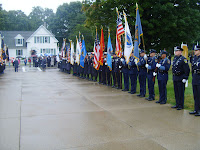
Today however it seems that honor is reserved only for the heroes returning from Iraq and Afghanistan or for the police officers, firefighters killed in line of duty. Not that they don't deserve honor, don't get me wrong. I am humbled that men and women serve and pay the ultimate price for our security and way of life. I am continually impressed and awed that dignitaries appear, that flags fly, that honor guards come out, that towns come together, that bells ring, and, yes, that traffic stops.
But our tradition--and our rules of the road--teaches us that everyone deserves that.
Last week, I was in a funeral procession. Call it an honor, call it a commandment, collect a privilege, call it whatever you want. I was astounded in dismayed at the lack of respect my fellow drivers showed to the funeral procession. It seems to me we need some changes. Some changes in regulation, some changes in technology, and some improvement in common sense and common decency.
 First the easier ones: technology. Today a fair percentage of cars have daytime running lights. In the old days, cars didn't drive during the day with their headlights on unless they were in a dark rain storm or if they were traveling in a funeral procession. You could see the line of cars coming with headlights on and knew that they were part of the funeral cortege, plain and simple. Today's processions' headlights--and even high beams and blinkers--too easily melt into the rest of the traffic flow and highway glare. For all the import they used to carry, strips of dayglo orange paper marked "FUNERAL" affixed to the inside of windshields or a white "FUNERAL" banner hanging from the rearview mirror don't give today's drivers enough of a clue, for the average driver is hurriedly traveling the road with coffee one hand and bluetooth impaled in the ear.
Small flashing lights magnetically attached to hoods or roofs; real flags attached similarly; signs affixed to car doors that stick out from the side. We need three dimensional clues. We need to be distracted enough by flying flag or flashing light to understand what is going on.
Beyond that, don't emergency vehicles have the capability to alter the programming of traffic lights they approach so that there is no (or less) traffic crossing ahead of them? Can't funeral homes be equipped with similar tools, so that traffic light patterns, especially those on popular cortege routes (Bridge Street/Spring Street at VFW Parkway in Dedham, and VFW and Baker Street in West Roxbury, for local examples), can be altered for the procession traffic?
Next is regulation. Processions traveling on highways need police escorts, period. Legislate it. But wait... do they need police escorts, or can we train civilian escorts? Think highway flag crews. Tough call (in Massachusetts at least), but worth thinking about.
Finally we need more common sense and common decency. Can't invent that, can't buy and stick it on cars. Can't legislate that either. All we can do is talk about that and teach our kids about it.
 Our Judeo-Christian culture teaches us respect for the dead. In fact one of the lasting lessons of my upbringing is the honor that it is to accompany the dead to the final resting place. I don't know if that's results being a child of the '60s and being inculcated with memories and images of JFK and Martin Luther King and Bobby Kennedy and so on. But from an early age there was always a respect for the funeral, and for the wake and the shiva and the yahrzeit and for the condolence call.
I remember, too, lessons from drivers education, learning that drivers in funeral processions need not stop for traffic lights and need not to wait for other traffic to pass--that the honor of driving in the procession and accompanying the dead to the cemetery was more important than daily traffic. I remember learning and I remember seeing cars stopped at traffic lights and waiting in other active travel lanes while funeral processions passed by.

Today however it seems that honor is reserved only for the heroes returning from Iraq and Afghanistan or for the police officers, firefighters killed in line of duty. Not that they don't deserve honor, don't get me wrong. I am humbled that men and women serve and pay the ultimate price for our security and way of life. I am continually impressed and awed that dignitaries appear, that flags fly, that honor guards come out, that towns come together, that bells ring, and, yes, that traffic stops.
But our tradition--and our rules of the road--teaches us that everyone deserves that.
Last week, I was in a funeral procession. Call it an honor, call it a commandment, collect a privilege, call it whatever you want. I was astounded in dismayed at the lack of respect my fellow drivers showed to the funeral procession. It seems to me we need some changes. Some changes in regulation, some changes in technology, and some improvement in common sense and common decency.

Small flashing lights magnetically attached to hoods or roofs; real flags attached similarly; signs affixed to car doors that stick out from the side. We need three dimensional clues. We need to be distracted enough by flying flag or flashing light to understand what is going on.
Beyond that, don't emergency vehicles have the capability to alter the programming of traffic lights they approach so that there is no (or less) traffic crossing ahead of them? Can't funeral homes be equipped with similar tools, so that traffic light patterns, especially those on popular cortege routes (Bridge Street/Spring Street at VFW Parkway in Dedham, and VFW and Baker Street in West Roxbury, for local examples), can be altered for the procession traffic?
Next is regulation. Processions traveling on highways need police escorts, period. Legislate it. But wait... do they need police escorts, or can we train civilian escorts? Think highway flag crews. Tough call (in Massachusetts at least), but worth thinking about.
Finally we need more common sense and common decency. Can't invent that, can't buy and stick it on cars. Can't legislate that either. All we can do is talk about that and teach our kids about it.
Friday, July 15, 2011
Understanding the Forgotten War
As mentioned in a previous post, I promised to read up on the Korean War. And so I have. And so I feel compelled to share some thoughts.
- Following the end of WWII, the allies divided control of the Korean peninsula arbitrarily at the 38th parallel; the Soviets controlling the North and the Americans the south. Cold war politics played its customary part here, although the Americans and its allies were more concerned with Europe than with Korea.
- North Korea has a small border with Russia at Vladivostok.
- The Korean conflict began in June 1950.North Korean troops, with a healthy dose of Soviet arms, advise, and aid, attacked and moved south. Seoul, the South Korean capital, fell quickly, and within weeks the North Koreans controlled almost the entirety of the peninsula, other than the south east section. The South Koreans and American forces held tight at a line by the Naktong River protecting only the port city of Pusan.
- With additional American forces arriving, the South Korean and American forces soon pushed the North Koreans back. By attacking and taking the west coast port of Inchon, they were able to disrupt the North Korean army, opening a second front. Within months, the American and South Korean forces had captured the North Korean capital of Pyongyang. Their forces eventually controlled almost the entire peninsula save for teh northernmost territory along the Chinese border.
- Now the Chinese army entered the conflict. By spring of 1951, Seoul had fallen again.
- American and South Korean forces, now also buttressed by UN forces from Britain, Turkey, Australia, and other countries, fought back, and by summer, the front had returned to approximately the 38th parallel. In a year, Seoul had changed hands four times.
- The following two years were fought in costly battles with little land be gained or lost. The Chinese seemed to be willing to wage a war of attrition with a huge cost in human life.
- Peace negotiations took place on and off for two years at Kaesong and Panmunjon. An armistice was signed in July of 1953.
- President-elect Eisenhower visited Korea personally in November 1952.
- Almost as many Americans died in combat in 3 years in Korea as did in 10 years in Vietnam. The total of American casualties (dead and missing) in Korea was over 42,000.
- Discovery of the atrocities of murder and defilement of captured American solders and South Korean soldiers and civilians was common.
- It is estimated that North Korean and Chinese combatant casualties numbered between 1.25 and 1.5 million.
- A major stumbling block to the final peace agreements was that a large number of North Korean and Chinese POWs did not want to be repatriated.
- The Korean war saw the first aerial battles between jet engine aircraft.
Friday, July 1, 2011
Sneaky Sneaky
Maybe I have been reading too many crime mystery books lately (and if you know me, when I say "read" I mean listen to audio books in the car).
And maybe I let my mind wander too much at times (and if you know me, you understand you need to either get excited or cringe when I say "I had an idea when I was... (insert activity here: feeding the horses; mowing the lawn; driving the tractor; etc)
Yesterday morning, my darling wife texted me that I should take the dog for a walk before it got too hot (for me? for the dog?). So I finished some work and started getting ready for a walk. I went outside to get my sneakers and there was only one. Looked around, no other sneaker. Looked inside, looked outside. looked on the porch and by the door and under the bushes, no other sneaker. Searched the memory banks to remember where I had gone the previous night--worked bingo and came home with both sneakers.
A few possible explanations: 1. Deb had dragged a box or bag on her way out in the morning and my sneaker got caught and was in the car. 2. some critter decided it needed my sneaker more than I did and absconded with it. 3. teenage prankster (but we don't really have a lot of that around here). 4. black hole, twilight zone, alternate dimension (ditto).
I called my wife and ask about possibility one. Nope, no dragging this morning. She asks if I had spilled something on my shoe that might have made possibility two more likely... not that I recall. Whatever. I slipped on an old pair of sneakers, got the dog, and headed out for the constitutional.
And while I was walking it all became clear:
Later, I went to the library, returned the new crime drama audiobook I had just started, and picked out something a bit lighter.
And maybe I let my mind wander too much at times (and if you know me, you understand you need to either get excited or cringe when I say "I had an idea when I was... (insert activity here: feeding the horses; mowing the lawn; driving the tractor; etc)
Yesterday morning, my darling wife texted me that I should take the dog for a walk before it got too hot (for me? for the dog?). So I finished some work and started getting ready for a walk. I went outside to get my sneakers and there was only one. Looked around, no other sneaker. Looked inside, looked outside. looked on the porch and by the door and under the bushes, no other sneaker. Searched the memory banks to remember where I had gone the previous night--worked bingo and came home with both sneakers.
A few possible explanations: 1. Deb had dragged a box or bag on her way out in the morning and my sneaker got caught and was in the car. 2. some critter decided it needed my sneaker more than I did and absconded with it. 3. teenage prankster (but we don't really have a lot of that around here). 4. black hole, twilight zone, alternate dimension (ditto).
I called my wife and ask about possibility one. Nope, no dragging this morning. She asks if I had spilled something on my shoe that might have made possibility two more likely... not that I recall. Whatever. I slipped on an old pair of sneakers, got the dog, and headed out for the constitutional.
And while I was walking it all became clear:
- She told me to go out for a long walk on our quiet rural street.
- She stole my sneaker, knowing that I would call her and see if she knew anything about that. The phone call fixed the exact time I would be going out.
- She could then call her hitman and tell him I was leaving
- Hitman drives down quiet rural street looking for me... probably in a shiny black SUV.
- Bang! Goodbye rotten good for nothing husband.
Later, I went to the library, returned the new crime drama audiobook I had just started, and picked out something a bit lighter.
Tuesday, June 14, 2011
PIMG
I admit to being a horrible typist. I can spell just fine, thanks. Typing... sometimes the fingers get a bit messed up. IM chats are the worst. As for text messaging and entering contact names on my mobile phone, I hate it, although the virtual keyboard of an iPhone is far FAR superior to the old telephone touch pad.
So being the geek that I readily admit I am, I send abbreviations when possible. Not your garden variety teenage BFF4eva, but more geeky meaningful messages. My wife Deb, a talented user (and typist) but certainly not a geekess, would often have trouble understanding that IHWTH means "I hate when that happens," and even ROFL needed explanation once upon a time. When leaving the house I would let Deb know I was doing so by sending her a "POOF." When I needed to reach out and let her know I was coming or going--or just thinking about her--a techy "PING" does the trick.
But the problem comes with the aforementioned typing.Somehow leaving the house one day, PING became PIMG. Never noticed it, never thought about it until Deb later that day asked me if I was proud that she was able to figure out that new abbreviation all by herself. Of course I was, but I had no ideas what she was talking about.
She explained it to me with justifiable pride: PIMG... "Poof I aM Gone!"
So being the geek that I readily admit I am, I send abbreviations when possible. Not your garden variety teenage BFF4eva, but more geeky meaningful messages. My wife Deb, a talented user (and typist) but certainly not a geekess, would often have trouble understanding that IHWTH means "I hate when that happens," and even ROFL needed explanation once upon a time. When leaving the house I would let Deb know I was doing so by sending her a "POOF." When I needed to reach out and let her know I was coming or going--or just thinking about her--a techy "PING" does the trick.
But the problem comes with the aforementioned typing.Somehow leaving the house one day, PING became PIMG. Never noticed it, never thought about it until Deb later that day asked me if I was proud that she was able to figure out that new abbreviation all by herself. Of course I was, but I had no ideas what she was talking about.
She explained it to me with justifiable pride: PIMG... "Poof I aM Gone!"
Tuesday, June 7, 2011
Shavuot: The Korean War of Jewish Holidays
Shavuot arrives tonight with Torah study, cheesecake and prayer. An enjoyable holiday no doubt. But it is misunderstood, ignored, and even forgotten. Just like the Korean War.
Every year in my school career when we studied history, we started fresh and new in September with the American Revolution, and made our way through nearly 200 years of American history--growth and expansions, wars and battles, elections and assassinations, statesmen and scoundrels, invention, innovation, and great institutions. Yet when the temperature rose and the field days and class trips became more frequent, World War II was wrapping up and the Cold War was on the horizon. Korea? no where to be found. Vietnam and Watergate were still then fresh and not yet history. JFK was a Boston icon and always at the top of the list. But somehow the late 40's to the early 70's disappeared into Flag Day and Summer Reading. Korea? All I know I learned from Hawkeye Pierce and Hot Lips Houlihan.
And in Hebrew School, Shavuot got the same cold shoulder. September started with the High Holidays, Sukkot getting a calender boost at the start and ending with a joyful Simchat Torah. The winter was filled with celebrations for Chanukah and then Purim, preparations for Pesach, planting tress in Israel for Tu B'Shevat, and inserting lessons of Tisha b'Av and the new observances of Yom HaShoah and Yom HaAtzmaut. Springtime brought Pesach and matzah crumbs, and as the weather warmed, the field day was repurposed for Lag b'Omer. Yet the third of the pilgrimages got lost amidst plans for graduation and summer trips. Poor Shavuot even gets the short shrift in duration, only two days compared to its eight day brethren--was it a shorter trip to Jerusalem in the Summer than Spring or Autumn?
So as an adult, now, with a better understanding of Zman Matan Torahteinu--and a book or two on the Krean War on my reading list--I look forward to some late night study, the story of Naomi and Ruth, and cheescake and blintzes!
Chag Sameach!
Every year in my school career when we studied history, we started fresh and new in September with the American Revolution, and made our way through nearly 200 years of American history--growth and expansions, wars and battles, elections and assassinations, statesmen and scoundrels, invention, innovation, and great institutions. Yet when the temperature rose and the field days and class trips became more frequent, World War II was wrapping up and the Cold War was on the horizon. Korea? no where to be found. Vietnam and Watergate were still then fresh and not yet history. JFK was a Boston icon and always at the top of the list. But somehow the late 40's to the early 70's disappeared into Flag Day and Summer Reading. Korea? All I know I learned from Hawkeye Pierce and Hot Lips Houlihan.
And in Hebrew School, Shavuot got the same cold shoulder. September started with the High Holidays, Sukkot getting a calender boost at the start and ending with a joyful Simchat Torah. The winter was filled with celebrations for Chanukah and then Purim, preparations for Pesach, planting tress in Israel for Tu B'Shevat, and inserting lessons of Tisha b'Av and the new observances of Yom HaShoah and Yom HaAtzmaut. Springtime brought Pesach and matzah crumbs, and as the weather warmed, the field day was repurposed for Lag b'Omer. Yet the third of the pilgrimages got lost amidst plans for graduation and summer trips. Poor Shavuot even gets the short shrift in duration, only two days compared to its eight day brethren--was it a shorter trip to Jerusalem in the Summer than Spring or Autumn?
So as an adult, now, with a better understanding of Zman Matan Torahteinu--and a book or two on the Krean War on my reading list--I look forward to some late night study, the story of Naomi and Ruth, and cheescake and blintzes!
Chag Sameach!
Subscribe to:
Comments (Atom)